What Is A Musical Scale?
Ever tried to work out a song by ear and kept landing on a note that just sounded... wrong?
Chances are that note was sitting outside the scale. And that's really what a scale is. A group of notes lined up in order, from low to high (or high to low), in a particular pattern. That pattern is what gives each scale its sound.
Every time you sing a melody or pick out a tune on a piano, you're using notes from a scale. Most of us just never stop to think about it.
Two words you'll see a lot are root and tonic. The root is the note a scale (or a chord) is built around. The tonic is the home note, the one that feels settled when the music comes back to it. In a scale they're usually the same note. In C major, C is both.
You'll also hear the word key. It tells you which note feels like home in a piece of music and which scale or group of notes the music is mainly using. For example, a song in C major has C as its home note and mainly uses the notes of the C major scale.
Western music uses 12 different notes before everything starts repeating at the next octave. A major scale picks seven of them. A pentatonic scale picks five. A whole tone scale picks six.
But it's not just about how many notes. It's about the distance between them.
These distances are called intervals. On a piano, going from one key to the very next one is a half step (also called a semitone). Two half steps make a whole step. Every type of scale is just a different recipe of whole steps and half steps.
Why Do You Need To Know About Music Scales?
Let me say this first. You don't need to become a music theorist. Nobody's going to test you!
But a little scale knowledge makes singing and playing a lot easier, because suddenly you can see how melodies and chords fit together. Here's where it really helps.
Singing and playing in tune. Practising a scale trains your ear to hear the distance between notes. If a note in your melody doesn't sound right, it might only be a half step away from where it should be. Play the scale slowly and sing along. You'll start to hear that difference.
Finding a comfortable key for your voice. Lots of songs are too high or too low in their original key. When you change key, every note moves up or down together and the melody stays the same shape. If you know the scale, it's much easier to follow along and find a key that feels relaxed. (And if you're straining for it, it's the wrong key. Simple as that.)
Singing harmony. Harmony is often thirds and sixths above the main melody. The scale shows you which notes fit. A third above a melody note can be major or minor depending on the scale you're in.
Understanding chords and writing melodies. Chords are usually built from the notes of a scale. So if you know which notes belong together, you've got a great starting point for writing a melody or choosing chords to go under it. And you can still step outside the scale any time you want a different flavour.
The 12 Notes: Sharps, Flats And Octaves
The 12 notes are C, C♯, D, D♯, E, F, F♯, G, G♯, A, A♯ and B.
On a piano, C D E F G A and B are the white keys. The black keys get sharp or flat names.
A sharp (♯) raises a note by one half step. A flat (♭) lowers it by one half step. The black key between C and D can be called C♯ or D♭. Same key, two names.
Notice there's no black key between E and F, or between B and C? That's because those pairs are already a half step apart.
Sometimes the same key gets written differently depending on the scale. In a seven-note scale each letter is normally used once. This is why F♯ major contains E♯. On a piano E♯ sounds exactly like F, but E♯ is the right spelling for that scale. It looks strange, but it keeps things tidy.
And when you get to the next C, you've gone up an octave. Same note name, higher sound. A singer can sing a melody an octave above or below another singer and they're still singing the same notes, just in a different register.
How A Major Scale Is Built In Every Key
C major is the best place to start because it's all white keys: C D E F G A B C. You might know it as do, re, mi, fa, sol, la, ti, do.
What matters is the pattern of steps. Whole, whole, half, whole, whole, whole, half. Every major scale in every key follows this exact pattern.
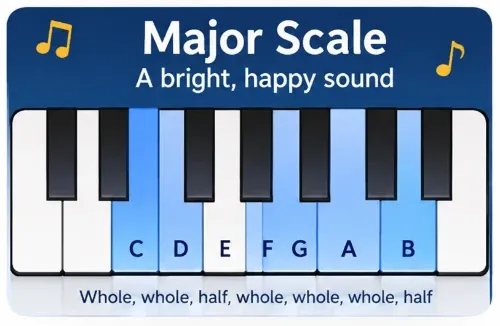
So you can build one from any note. Let's try G major.
Start on G. Go up a whole step to A. Another whole step to B. Then a half step to C. Up to D, up to E. Now the next whole step takes you to F♯, not F. And one last half step brings you home to G.
G A B C D E F♯. The pattern didn't change from C major. Only the notes did. Sharps and flats just get added wherever they're needed to keep the pattern the same.
| Key | Notes | Sharps or flats | Relative minor |
|---|---|---|---|
| C | C D E F G A B | None | A minor |
| G | G A B C D E F♯ | 1 sharp | E minor |
| D | D E F♯ G A B C♯ | 2 sharps | B minor |
| A | A B C♯ D E F♯ G♯ | 3 sharps | F♯ minor |
| E | E F♯ G♯ A B C♯ D♯ | 4 sharps | C♯ minor |
| B | B C♯ D♯ E F♯ G♯ A♯ | 5 sharps | G♯ minor |
| F♯ | F♯ G♯ A♯ B C♯ D♯ E♯ | 6 sharps | D♯ minor |
| G♭ | G♭ A♭ B♭ C♭ D♭ E♭ F | 6 flats | E♭ minor |
| D♭ | D♭ E♭ F G♭ A♭ B♭ C | 5 flats | B♭ minor |
| A♭ | A♭ B♭ C D♭ E♭ F G | 4 flats | F minor |
| E♭ | E♭ F G A♭ B♭ C D | 3 flats | C minor |
| B♭ | B♭ C D E♭ F G A | 2 flats | G minor |
| F | F G A B♭ C D E | 1 flat | D minor |
F♯ and G♭ are the same piano keys with different names, and you'll see both in real music. The relative minor column shows the minor key that shares the same notes as each major key. C major and A minor, for example, both use only the white keys. The difference is which note feels like home.
Minor Scales: Natural, Harmonic And Melodic
Minor scales sound different to major ones. Natural minor tends to sound darker or more serious, although a lot depends on how the notes are used in the song.
A minor is the easiest example: A B C D E F G A. Same white keys as C major, but now A is home.
Harmonic minor changes just one note. The 7th gets raised by a half step. In A harmonic minor, G becomes G♯, so you get A B C D E F G♯. That makes a bigger gap between the 6th and 7th notes, and that gap is what gives the scale its dramatic sound.
Melodic minor changes the 6th and 7th going up. In A melodic minor, F becomes F♯ and G becomes G♯. In classical music it usually goes back to natural minor on the way down. Jazz melodic minor keeps the raised 6th and 7th in both directions.
Scale Modes Explained
Modes sound complicated, but here's an easy way to think about them.
Play the white keys on a piano from C up to the next C. That's C Ionian, which is just the C major scale. Now play the same white keys from D to the next D. That's D Dorian.
Same notes. Different home note. And that changes the intervals around the home note, which gives each mode its own character.
The seven modes are Ionian, Dorian, Phrygian, Lydian, Mixolydian, Aeolian and Locrian.
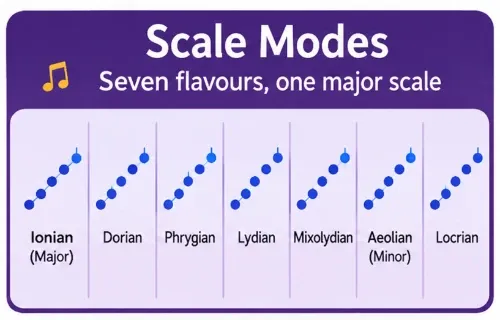
| Mode | Starts on (white keys) | Formula | Built on C | Sound |
|---|---|---|---|---|
| Ionian (major) | C | 1 2 3 4 5 6 7 | C D E F G A B | Bright and happy |
| Dorian | D | 1 2 ♭3 4 5 6 ♭7 | C D E♭ F G A B♭ | Minor, but with a lift. Hopeful |
| Phrygian | E | 1 ♭2 ♭3 4 5 ♭6 ♭7 | C D♭ E♭ F G A♭ B♭ | Dark, a bit Spanish |
| Lydian | F | 1 2 3 ♯4 5 6 7 | C D E F♯ G A B | Light, dreamy, floaty |
| Mixolydian | G | 1 2 3 4 5 6 ♭7 | C D E F G A B♭ | Major with a bluesy rock edge |
| Aeolian (natural minor) | A | 1 2 ♭3 4 5 ♭6 ♭7 | C D E♭ F G A♭ B♭ | Sad, serious |
| Locrian | B | 1 ♭2 ♭3 4 ♭5 ♭6 ♭7 | C D♭ E♭ F G♭ A♭ B♭ | Tense, unsettled |
The formula shows how each mode differs from a major scale starting on the same note. A ♭ lowers a note by a half step and a ♯ raises it. So C Dorian has E♭ and B♭ where C major has E and B.
Best advice? Don't just read it. Play C Ionian, then C Dorian. Keep C as your home note both times and listen to what the changed intervals do to the sound. Ionian is the major scale and Aeolian is natural minor. The other five each have their own colour, and you'll hear it quickly once you try them back to back.
Types Of Musical Scales In The Tool
Major and minor are just two scales out of many. Some have five notes, some six, seven or even eight. You'll hear them in blues, rock, jazz, classical and music from all over the world.
Now, you don't need to learn them all at once. Start with major, natural minor and the pentatonic scales. Once you can hear and sing those patterns, then go exploring. And playing a scale is nearly always more useful than memorising its formula.
| Scale | Notes on C | Formula | What to know |
|---|---|---|---|
| Major pentatonic | C D E G A | 1 2 3 5 6 | Open and bright. Really easy to sing because the notes that clash are left out. |
| Minor pentatonic | C E♭ F G B♭ | 1 ♭3 4 5 ♭7 | The one behind a lot of rock, blues, soul and R&B riffs and melodies. |
| Blues | C E♭ F G♭ G B♭ | 1 ♭3 4 ♭5 5 ♭7 | Minor pentatonic with one extra note, the “blue note” (♭5). |
| Harmonic minor | C D E♭ F G A♭ B | 1 2 ♭3 4 5 ♭6 7 | Dramatic. It’s natural minor with the 7th raised. |
| Jazz melodic minor | C D E♭ F G A B | 1 2 ♭3 4 5 6 7 | A minor 3rd, but a major 6th and 7th. Smooth, very jazzy. |
| Whole tone | C D E F♯ G♯ B♭ | 1 2 3 ♯4 ♯5 ♭7 | Every step is a whole step, so it floats around with no real home note. |
| Octatonic (whole-half) | C D E♭ F G♭ A♭ A B | 1 2 ♭3 4 ♭5 ♭6 6 7 | Whole step, half step, whole step, half step... Also called the diminished scale. Tense. |
| Acoustic | C D E F♯ G A B♭ | 1 2 3 ♯4 5 6 ♭7 | Lydian with a flat 7th. You’ll also hear it called Lydian dominant. Big in jazz. |
| Phrygian dominant | C D♭ E F G A♭ B♭ | 1 ♭2 3 4 5 ♭6 ♭7 | That Spanish, flamenco sound. |
| Hirajoshi | C D E♭ G A♭ | 1 2 ♭3 5 ♭6 | Five notes, from Japanese music. |
| Altered | C D♭ E♭ F♭ G♭ A♭ B♭ | 1 ♭2 ♭3 ♭4 ♭5 ♭6 ♭7 | Every note except the root is lowered compared with major. A jazz favourite. |
There are a few more in the tool too: major and dominant bebop, Lydian augmented, augmented, half diminished, major Locrian, harmonic major, double harmonic, Hungarian minor, Dorian ♭2 and enigmatic. Some turn up mostly in jazz, others belong to particular musical traditions. Play them and hear how different they sound.
Scale Degrees And Intervals: How To Read The Note Cards
The note cards under the piano show you a bit more than the note name. Each one also shows the scale degree, the interval from the root, and the number of half steps. Together they tell you where a note sits in the scale and how far it is from home.
Scale degrees. These number the notes from 1 to 7. The first degree is the tonic, your home note. When you see ♭3, it means the 3rd is lowered by a half step compared with a major scale. And that lowered 3rd is one of the biggest differences between major and minor.
Each degree has a name as well: tonic, supertonic, mediant, subdominant, dominant, submediant and leading note. The dominant (the 5th) is the interesting one. It pulls towards the tonic. That's why so many songs go to a dominant chord just before landing back on the home chord.
Intervals. An interval is simply the distance between two notes. P is perfect, M is major, m is minor, A is augmented and d is diminished. So m3 is a minor third and P5 is a perfect fifth. The half steps column gives you the exact distance on a piano.
| Half steps | Short name | Full name | Note above C |
|---|---|---|---|
| 0 | P1 | Perfect unison | C |
| 1 | m2 | Minor 2nd | D♭ |
| 2 | M2 | Major 2nd | D |
| 3 | m3 | Minor 3rd | E♭ |
| 4 | M3 | Major 3rd | E |
| 5 | P4 | Perfect 4th | F |
| 6 | A4 / d5 | Tritone | F♯ / G♭ |
| 7 | P5 | Perfect 5th | G |
| 8 | m6 | Minor 6th | A♭ |
| 9 | M6 | Major 6th | A |
| 10 | m7 | Minor 7th | B♭ |
| 11 | M7 | Major 7th | B |
| 12 | P8 | Octave | C |
Here's something to try. Sing from C to another note in the table, then sing back down to C. Do it with a few different intervals. After a while you'll start recognising them by ear, without looking at the piano every time.
Diatonic And Non-Diatonic Notes
Diatonic just means the note belongs to the scale or key you're in. In C major the diatonic notes are C, D, E, F, G, A and B. Anything else is non-diatonic.
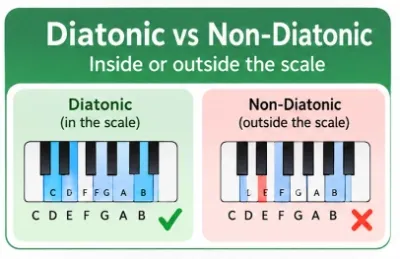
But a non-diatonic note isn't automatically a wrong note!
Songwriters use notes outside the scale all the time to add tension, colour or movement. The blue note in blues music is one. The raised 7th in harmonic minor is another.
So when you pick a scale, look at the highlighted keys on the piano. If a note in your melody sounds unusual, compare it with those keys. It might be a mistake. Or it might be exactly the note that gives your melody its character.
Chords That Belong To A Scale
Chords are usually built from the notes of a scale. Here's how it works in C major.
Start on C. Skip D. Take E. Skip F. Take G. C, E and G together make a C major chord.
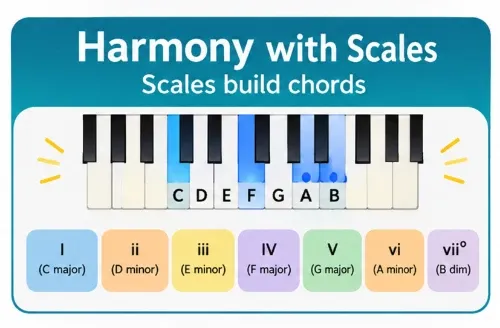
Do the same thing starting from each note of the scale and you end up with seven basic chords:
| Number | Chord | Notes |
|---|---|---|
| I | C major | C E G |
| ii | D minor | D F A |
| iii | E minor | E G B |
| IV | F major | F A C |
| V | G major | G B D |
| vi | A minor | A C E |
| vii° | B diminished | B D F |
The Roman numerals tell you where each chord sits in the scale. Capital letters are major chords, lowercase are minor, and the ° is a diminished chord. In any major key the pattern is the same: major, minor, minor, major, major, minor, diminished.
A huge number of songs use just the I, IV, V and vi chords. In C major that's C, F, G and Am. In G major it's G, C, D and Em. The tool also shows seventh chords and extras like Add9, Add11 and Add13. Click a chord, hear it, then compare it with the single notes of the scale.
How To Use The Music Scales Tool, Step By Step
Don't wait until you understand all the theory. Pick a scale, play it, and listen to how the notes fit together. The extra information will make more sense as your ear gets used to the sound.
- Choose a root note. If you're new to scales, start with C. C major is all white keys.
- Choose a scale. Try Major (Ionian) or Minor (Aeolian) first, then pick something else from the list.
- Play the scale. Start slow, around 60 or 80 BPM. You can play it ascending, descending or both.
- Follow the piano. The scale notes light up and the root is marked in red. You can show note names or scale degrees on the keys.
- Check the information. Have a look at the notes, key signature, related major scale and spelling.
- Play single notes. Tap any piano key or note card to hear it.
- Try the chords. Open the chord section to see and hear chords built from your scale.
- Use the scale finder. Pick a few notes and it shows you every scale that contains them.
One thing to know. Playback starts in the octave below middle C. If that's too high or low for your voice, just sing an octave up or down, or choose a different root note. Never strain to match the piano!
You might also see a “Rare key” message. It just means the correct spelling of that key needs double sharps or double flats. G♯ major, for example, uses F double sharp. A♭ major sounds the same but is much easier to read, so the tool may suggest A♭ instead.
Find A Scale From Notes: What Key Is My Melody In?
Sometimes you know the notes of a melody but have no idea which scale they come from. That's what the scale finder is for. Enter the notes you've worked out and it shows every scale that contains all of them.
Try this. Enter D, E, F♯, G, A, B and C♯. You'll get D Major, E Dorian, F♯ Phrygian, G Lydian, A Mixolydian, B Minor and C♯ Locrian. Seven scales, exactly the same notes. The only thing that changes is the home note.
And this is where the tonic really helps. Listen to your melody and ask yourself: which note feels settled? Which one does the music keep coming back to? That's usually your key or mode. The last note of a song isn't always the tonic though, so listen to the whole melody and don't just rely on how it ends.
The more notes you enter, the better the results. Two or three notes will fit into lots of different scales, so it's hard to pin one down. Also, the finder works with notes you type in. It can't pick out notes from a recording or from your voice.
Spelling can change the results too. E♭ and D♯ are the same piano key but they belong to different scale spellings. Leave the spelling option unticked for an exact match, or tick it to treat them as the same pitch.
So go and have a play with it. Slow, simple and a little bit every day... that's all it takes for these patterns to start sounding familiar.